

Causes, symptoms and effective treatment
Vitreolysis with YAG laser – treatment for vitreous floaters
Troubled by floaters? Many people experience so-called vitreous opacities, also known as floaters, as dark spots, threads, rings or cobweb-like shadows moving across the field of vision. For some these changes are barely noticeable, while for others they can be very disturbing in everyday life. At our clinic we offer vitreolysis with YAG laser, a modern and gentle treatment method for selected patients with troublesome floaters.
The latest equipment for diagnosis and treatment
Over 30 years of experience
High patient satisfaction
What are floaters?
Floaters appear when small condensations form in the vitreous — the gel-like substance that fills the inside of the eye.
As light passes through the eye, these condensations cast shadows on the retina, which you may experience as:
Dark spots
Threads or lines
Rings or circles
Cobweb-like shapes
Moving shadows in your field of vision
They are usually most noticeable against bright, even backgrounds, for example:
A white wall
A computer screen
Snow-covered ground
A clear sky

Understanding eye floaters and laser solutions
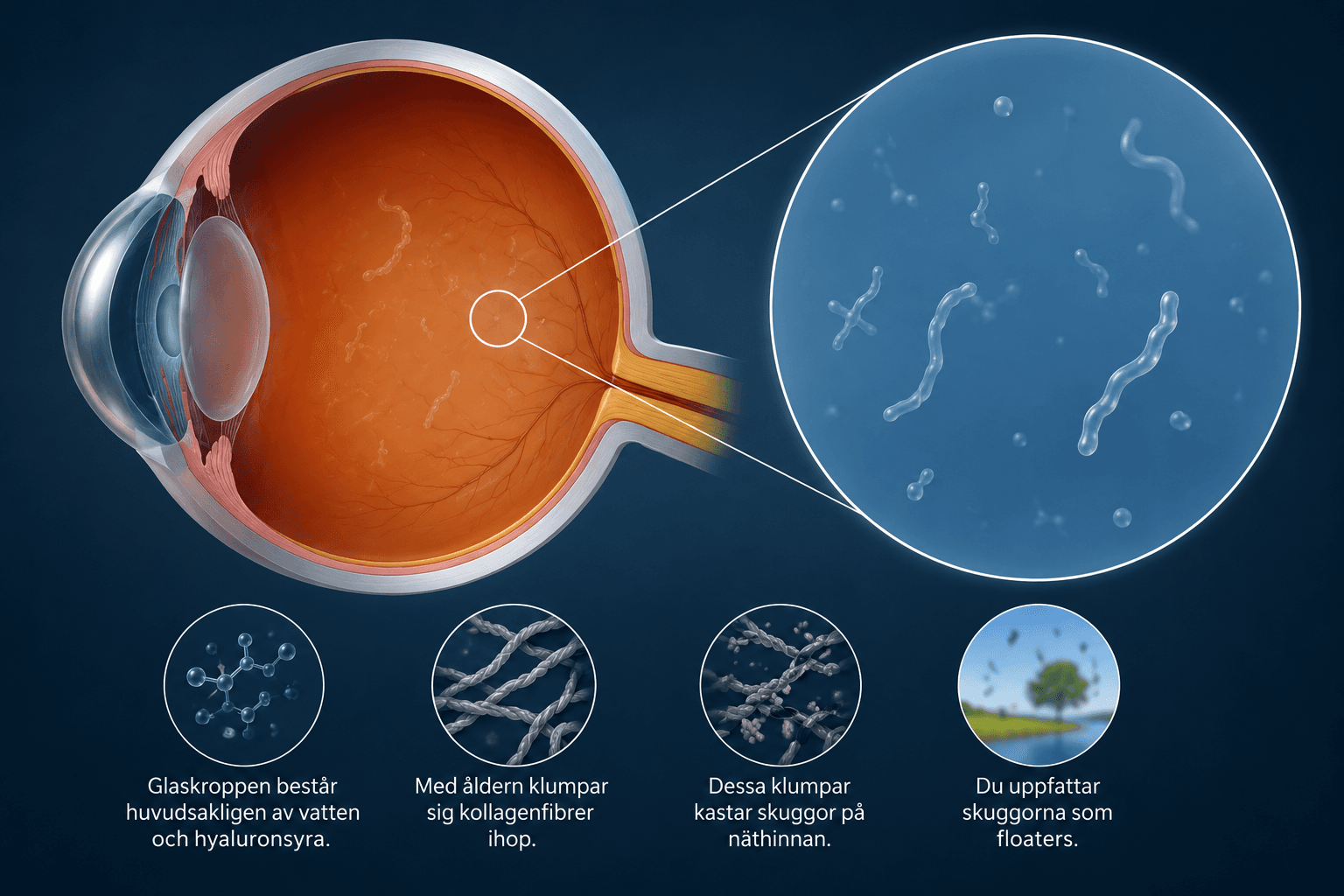
Why do vitreous opacities occur?
The most common cause is natural age-related change in the vitreous.
Over time the vitreous becomes less uniform and parts of it can clump together. This is a normal part of how the eye ages and occurs in many adults.
Floaters can also arise in connection with:
Posterior vitreous detachment (PVD)
Short-sightedness
Eye surgery
Eye injuries
Inflammation inside the eye
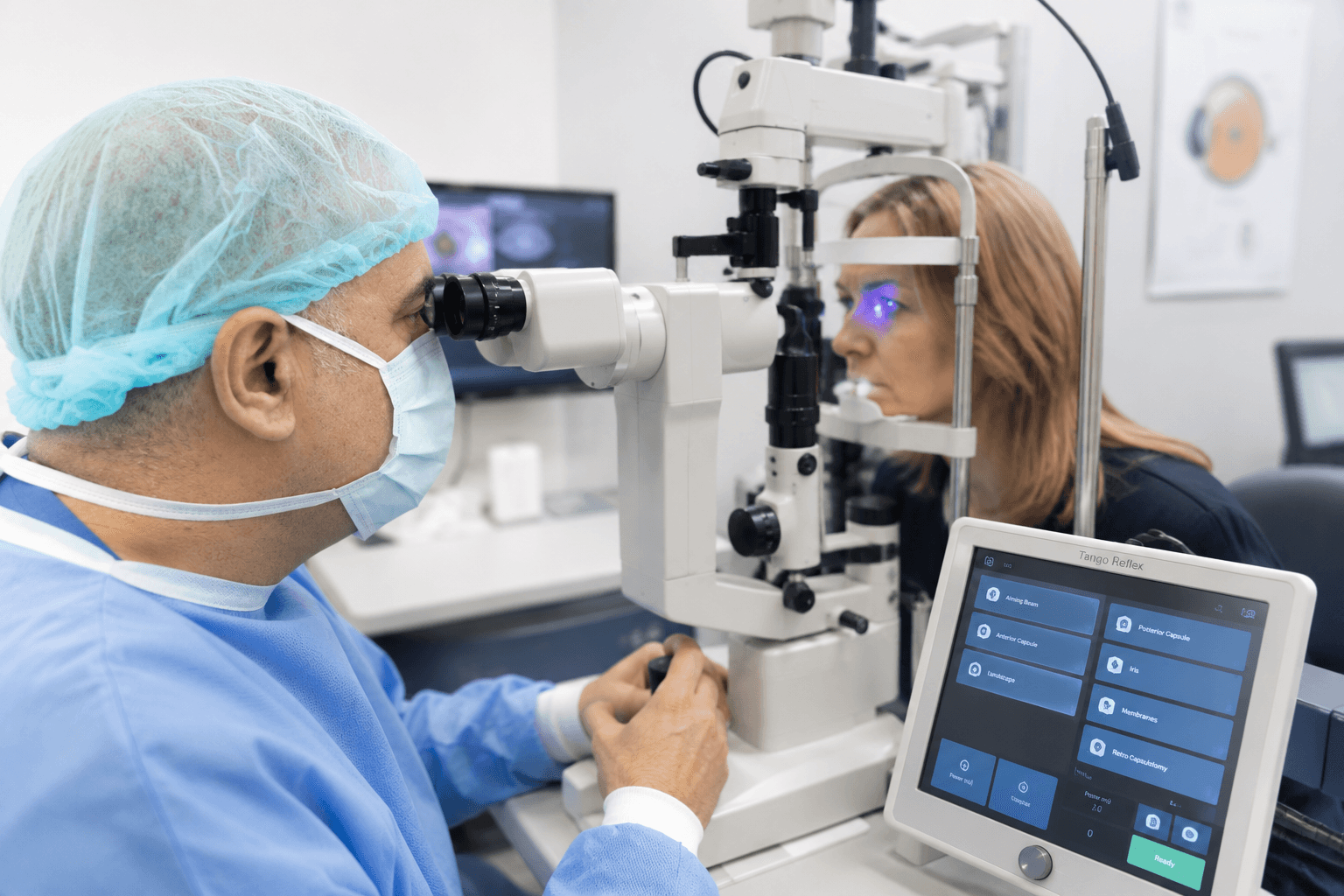
What is vitreolysis?
Vitreolysis is a laser treatment in which a specially adapted Nd:YAG laser is used to treat vitreous opacities.
During the treatment, laser pulses are directed at the opacities in the vitreous. The laser breaks up or vaporises part of the opacity so that it becomes less visible and less disturbing.
The aim is to reduce the patient's symptoms and improve visual comfort.
How is the treatment carried out?
1. A thorough eye examination
A comprehensive examination of the eye is carried out first.
We assess:
The type of floater
Its size and position
The distance to the retina
The distance to the lens of the eye
Whether vitreolysis is a suitable treatment
Not all floaters are suitable for laser treatment.
2. Preparation
The eye is dilated with drops. Anaesthetic drops are used to make the treatment comfortable.
3. Laser treatment
A special lens is placed against the eye and the doctor directs the YAG laser at the opacities.
The treatment is not normally painful. Most people mainly notice flashes of light from the laser.
4. Check-up
After the treatment the eye is checked before you leave the clinic.
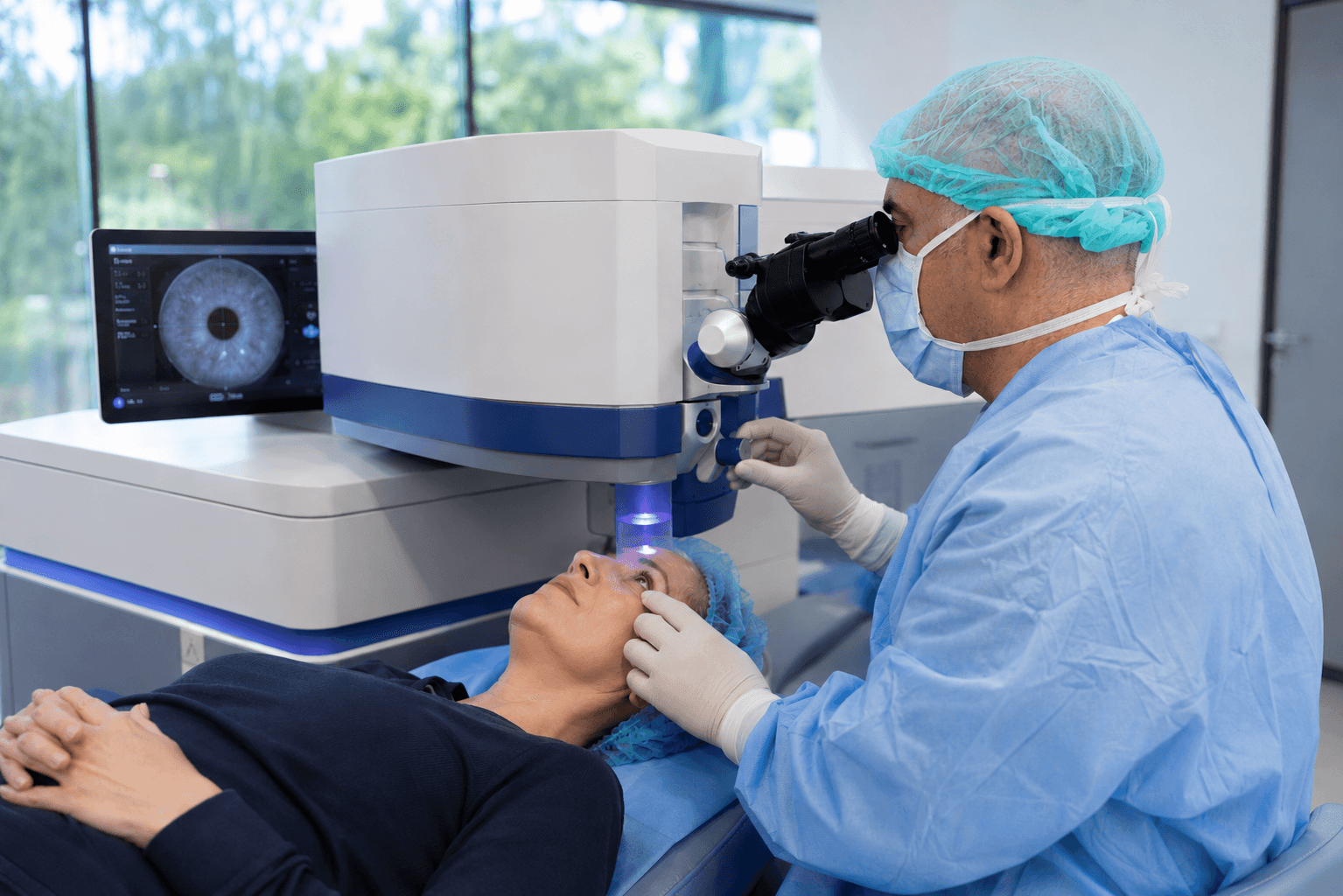
How long does the treatment take?
The treatment usually takes between 15 and 30 minutes, depending on the number and type of floaters.
In some cases more than one treatment may be needed for the best result.
Who is vitreolysis suitable for?
Vitreolysis is best suited to patients who:
Are clearly troubled by floaters
Have stable symptoms
Have well-defined opacities
Have floaters at a safe distance from the retina and the lens
An individual assessment is always required.
When is vitreolysis not suitable?
The treatment is not always the right choice.
Examples of situations where vitreolysis may be less suitable:
Very diffuse opacities
Opacities close to the retina
Opacities close to the lens of the eye
Active eye disease
Certain types of inflammation or retinal problems
At the examination we go through which options are best for you.

What results can you expect?
Results vary from patient to patient.
Many people experience:
Reduced visibility of floaters
Fewer disturbing shadows
Improved visual comfort
Better quality of life
It is important to understand that the aim is usually to reduce the symptoms, not necessarily to eliminate every floater completely.
Is vitreolysis safe?
When carried out on carefully selected patients by an experienced ophthalmologist, vitreolysis is generally a safe method.
As with all medical treatment, however, there are potential risks and complications. These can include:
Temporary irritation
Raised intraocular pressure
Inflammation
Damage to the lens or retina (uncommon)
This is why correct patient selection and experience matter particularly.

Contact us – we'll help you find the right treatment
Which treatment suits your eyes? Tell us briefly what you would like help with and we will get in touch. Our experienced specialists answer your questions and guide you to the treatment or examination that fits your needs.

X-Vision Ögonklinik
Hyllie Stationstorg 2
215 32 Malmö
FAQ – vitreolysis treatment

What are vitreous opacities — and why do they occur?
Vitreous opacities, often called floaters, are small condensations in the vitreous of the eye that can be seen as spots, threads, rings or shadows in the field of vision. They are usually most obvious against bright, even backgrounds such as a white wall, a computer screen or a clear sky.
The opacities usually arise as the vitreous changes with age. The gel-like vitreous gradually becomes more liquid, and its collagen fibres can clump together and form structures that cast shadows on the retina.
Are vitreous opacities dangerous?
In most cases vitreous opacities are harmless, even though they can be disturbing and affect how you see. It is nonetheless important to examine the eye first, to rule out other causes of the symptoms.
If you suddenly develop many new floaters, flashes of light, or a dark shadow or "curtain" in your field of vision, you should seek eye care promptly. Such symptoms can in some cases be a sign of a change in the retina that needs to be assessed quickly.
What is vitreolysis and how does the treatment work?
Vitreolysis is a laser treatment used to reduce problems from certain types of vitreous opacity.
During the treatment, short laser pulses are directed at selected opacities in the vitreous. The laser energy can break up or vaporise part of the opacity so that it becomes less prominent and disturbs vision less.
The treatment is carried out without surgical incisions and usually takes place at an outpatient visit.
Is vitreolysis suitable for everyone with vitreous opacities?
No. Not all types of vitreous opacity are suitable for vitreolysis. Whether treatment is possible depends among other things on the size, shape and position of the opacities and on their distance from the retina and the lens of the eye.
A thorough eye examination is therefore carried out first, in which the ophthalmologist assesses the vitreous and the other structures of the eye. We can then determine whether vitreolysis is a suitable treatment option.
What happens during a vitreolysis treatment?
Before the treatment the pupil is dilated and the eye is anaesthetised with drops. The ophthalmologist then uses a special contact lens in order to direct the laser at the relevant opacities in the vitreous.
The laser treatment itself is usually relatively short and you can normally go home the same day. Your vision may be temporarily affected afterwards, partly because of the dilating drops.
Does the treatment hurt?
Vitreolysis is not normally painful. The eye is anaesthetised with drops before the treatment, and most people mainly notice flashes of light from the laser during it.
Afterwards your vision may be temporarily blurred or sensitive to glare while the dilating drops are still working.
Do all the opacities disappear after treatment?
The aim of vitreolysis is above all to reduce the opacities that disturb vision — not to make the vitreous completely free of opacities.
The result varies depending on what type of opacities you have and where they are positioned. Some people experience a clear improvement after treatment, while others may still have opacities to a varying degree.
Is one treatment enough?
This varies from person to person. In some cases one treatment can be sufficient, while others may need further treatment sessions to achieve the desired result.
At the examination, and after the first treatment, the ophthalmologist assesses whether further treatment may be appropriate.
How quickly do you notice the result?
Some people experience an improvement relatively soon after the treatment, while for others it can take longer before vision settles and the result can be judged.
How great the improvement is depends among other things on the type, size and position of the opacities.
Are there risks with vitreolysis?
As with all treatment inside the eye there are risks, and vitreolysis should therefore only be carried out after a careful medical assessment.
Before the treatment the ophthalmologist goes through the expected effect, the possible risks, and whether your particular vitreous opacities are suitable for laser treatment. If vitreolysis is not judged to be a suitable option, you are told so at the examination.